
Tyreek Hill and the Kansas City Chiefs: A Game-Changing Legacy
There was a very specific sound at Arrowhead Stadium whenever Tyreek Hill got a step on a cornerback. Not quite a roar, more like the whole building holding its breath at once, waiting for the moment he’d hit top gear and the play would just end, forty yards downfield, in the end zone. Fans still talk about that feeling, which is a big part of why the Tyreek Hill Kansas City Chiefs partnership still comes up on sports radio years after he left town. Between 2016 and 2021, Hill didn’t just put up numbers for Kansas City. He forced the entire league to rethink how a defense has to play when one receiver can turn a five-yard hitch into a touchdown. This piece walks through how he got there, what the stats actually mean once you interpret them instead of just listing them, why the split with Kansas City happened, and why Chiefs Kingdom still throws up the peace sign at tailgates today.

Quick take: Tyreek Hill’s Kansas City legacy rests on speed that reshaped opposing game plans, not just yardage. From 2016 to 2021, his deep-threat gravity opened up the middle of the field for Travis Kelce and the rest of Andy Reid’s offense, helping the Chiefs reach two Super Bowls and win their first title in 50 years.
Why the Tyreek Hill Kansas City Chiefs Era Changed NFL Offenses Forever
Tyreek Hill changed the Chiefs by making defensive coordinators play backward, literally. His speed forced safeties to line up ten, sometimes fifteen yards off the ball just to avoid getting torched deep, and that opened up the short and intermediate routes for Kelce and everyone else in the passing game. It wasn’t just track speed dressed up as football talent. It was a structural problem coaches couldn’t fix with scheme alone. Once Patrick Mahomes took over at quarterback in 2018, that threat became the backbone of one of the most explosive offenses the league has ever seen.
Even Mahomes has said as much. Looking back on how defenses adjusted to Hill’s presence on the outside, the quarterback later told CBS Sports that “a lot of that shell coverage was because of the speed that we had on the outside.” That single line sums up years of defensive game-planning in Kansas City’s favor.
From Draft Pick to NFL Superstar
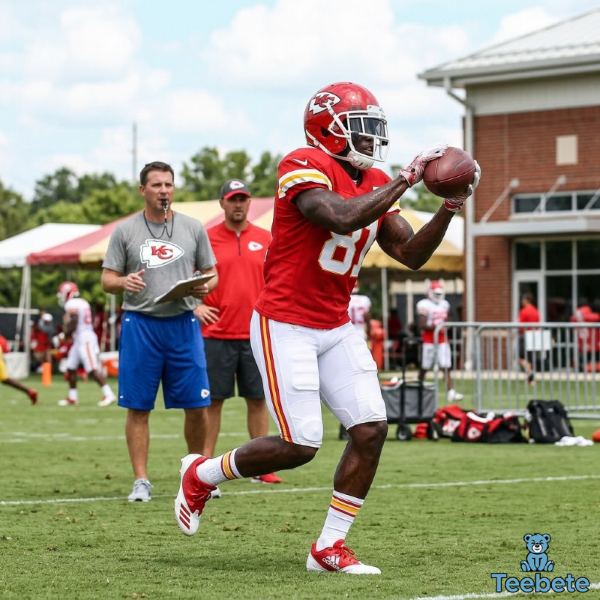
Tyreek Hill’s Kansas City Chiefs career officially began with that fifth-round selection in the 2016 NFL Draft, a low-risk flier nobody expected to matter this much.
Entering Kansas City in 2016
Hill’s path to the NFL wasn’t clean, and it’s worth saying plainly rather than glossing over it. At Oklahoma State, he was dismissed from the program following a domestic violence conviction, which sent him to West Alabama to rebuild both his college résumé and his life. That history is why a player with his measurables didn’t hear his name called until the fifth round. The Chiefs took him 165th overall in the 2016 NFL Draft, a low-risk, developmental pick on paper, brought in mostly as a returner and situational weapon rather than a future centerpiece.
Early Signs of a Unique Talent
The signs showed up fast anyway. Hill scored a touchdown on the first pass thrown his way in his first regular-season game, and by the end of his rookie year he’d racked up 593 receiving yards and 6 touchdowns to go with return production that earned him a Pro Bowl nod as a special teamer. In 2017, still playing alongside Alex Smith at quarterback, he crossed 1,000 receiving yards for the first time, a sign the return specialist label was about to become obsolete. For background on Hill’s draft stock and rookie trajectory, the NFL Draft profile is a solid reference.
The Mahomes and Hill Partnership That Redefined NFL Offense
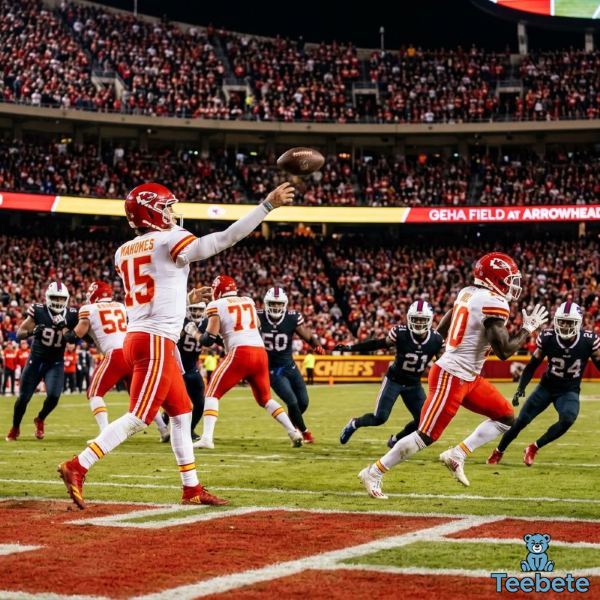
At its peak, Tyreek Hill’s time with the Kansas City Chiefs became the benchmark for explosive football across the NFL. Most retrospectives on this era stop at “they put up huge numbers together.” That undersells what actually happened. The Mahomes-Hill connection worked because it solved a timing problem most quarterback-receiver combos never solve. Mahomes could throw a ball 55 yards in the air before Hill had even finished his route, trusting that Hill’s closing speed would let him adjust and still be underneath it. Most deep threats need a perfectly designed play and a clean release to hit a home run. Hill could turn a broken play or a simple go route into six points because defenses physically could not afford to play him straight.
That gap between Hill and every other deep threat in the league is exactly why analysts still measure him against the other legendary Chiefs receiving stars in franchise history, from Otis Taylor’s era through today’s roster.
The Deep Ball That Changed Defensive Football
Defensive coordinators responded by rebuilding entire game plans around him. Two deep safeties became the default, Hill got bracketed even on running downs, and defenses sacrificed run-fit discipline just to keep a player over the top. That tactical shift is easy to miss on a highlight reel, but it’s a big reason Kansas City’s offense as a whole averaged more than 28 points a game across several of those seasons.
Signature Plays Every Chiefs Fan Remembers
Ask any Chiefs fan for their favorite Hill moment and the answer changes depending on their age and where they were sitting. For a lot of people it’s the comeback in Super Bowl LIV, where Hill caught nine passes for 105 yards, including a 44-yard grab on third-and-15 that flipped the game against San Francisco. For others it’s the 269-yard, three-touchdown eruption against Tampa Bay in 2020, or a specific “Wasp” concept, the tight-formation route combination Andy Reid dialed up to spring Hill loose against man coverage, that broke a game open in the fourth quarter. Kansas City rode that offense to a 31-20 win over the 49ers, the franchise’s first championship in 50 years. For a fuller breakdown of how that comeback unfolded, NFL.com’s Super Bowl LIV recap is worth a read.
Tyreek Hill Chiefs Stats That Explain His Legacy

Numbers alone tell you Hill was productive. What they don’t tell you, until you dig in, is how consistent he was. Here’s his full season-by-season output with Kansas City:
| Season | Games | Receiving Yards | Receiving TDs | Pro Bowl |
|---|---|---|---|---|
| 2016 | 16 | 593 | 6 | Yes |
| 2017 | 15 | 1,183 | 7 | Yes |
| 2018 | 16 | 1,479 | 12 | Yes |
| 2019 | 12 | 860 | 7 | Yes |
| 2020 | 15 | 1,276 | 15 | Yes |
| 2021 | 17 | 1,239 | 9 | Yes |
Source: verified season statistics via StatMuse and Pro Football Reference.
Six seasons in Kansas City, six Pro Bowl selections. Hill went on to make the Pro Bowl in each of his first eight NFL seasons, a streak no other wide receiver in league history has matched. What jumps out on closer look isn’t the peak, it’s the floor. Even in an injury-shortened 2019, when he missed four games, Hill still averaged nearly 72 receiving yards per game he played. His postseason work backs that up too: in the AFC Championship win over Buffalo that sent Kansas City to Super Bowl LV, Hill caught 9 passes for 172 yards, proof his production wasn’t just a product of a soft regular-season schedule. Three times with Kansas City, in 2016, 2018, and 2020, he earned first-team All-Pro honors, which is a big part of why the Tyreek Hill Kansas City Chiefs stat line still holds up against any receiver of his era.
More Than Statistics: The Cultural Impact on Chiefs Kingdom

Why the Peace Sign Became an NFL Icon
Hill’s touchdown celebration, two fingers up, a quick nod, sometimes a little shimmy, became shorthand for the entire era. It showed up on custom cleats, on fan signage at Arrowhead, in kids’ end-zone celebrations at Pop Warner games across Missouri and Kansas. It’s a small gesture, but it did what the best sports iconography does: it gave fans a way to physically take part in a moment they only watched happen.
The Rise of Number 10 Game Day Culture
Walk through the Arrowhead parking lot on a Sunday during the Hill era and the number 10 was everywhere: jerseys, face paint, custom flags tied to truck beds. Part of that is straightforward fandom. Part of it is that Hill represented something specific inside Chiefs Kingdom’s identity, speed, swagger, a refusal to play it safe. That instinct hasn’t gone away. Throwback jerseys from his rookie year still show up at tailgates, and the “Cheetah” nickname still gets chanted at Arrowhead, usually right before a Xavier Worthy deep ball, since Worthy has inherited a lot of that same vertical-threat identity in the current offense. Years later, Tyreek Hill’s Chiefs legacy is still one of the defining identities of modern Chiefs Kingdom.
That nostalgia has spawned a distinct game-day style around Arrowhead. Instead of grabbing whatever’s newest off the rack, a lot of die-hard fans go looking for tribute pieces that reference a specific season or a specific play, the Wasp call, the peace sign, the Super Bowl LIV comeback, rather than just the current roster. At Teebete, we see the same pattern in Chiefs apparel more broadly: fans respond most to gear tied to one unforgettable season or one Arrowhead memory, not to whatever jersey number is trending that week.
Why Tyreek Hill Left Kansas City
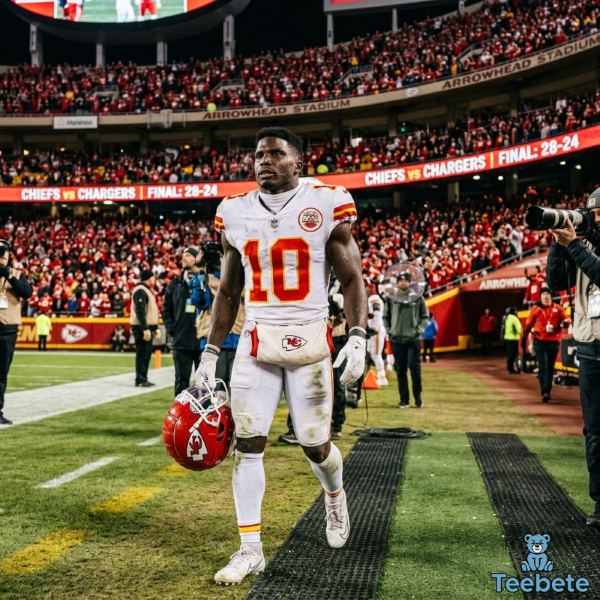
For all the production, this partnership eventually ran into a business problem it couldn’t outrun. Hill’s departure came down to money and timing more than any single dramatic blowup. After the 2021 season, Kansas City faced a hard calculation: pay a 28-year-old receiver a record-setting extension, or use that cap space to rebuild an offensive line and defense that had shown real cracks in the Super Bowl LV loss to Tampa Bay. On March 24, 2022, the Chiefs traded Hill to the Miami Dolphins, where he signed a deal that briefly made him the highest-paid wide receiver in football. From Kansas City’s side, it was a bet that Andy Reid’s system, not any single player, was the real engine of the offense. From Hill’s side, it was a chance to get paid market rate in an offense built around his exact skill set. Both bets turned out to have real merit, which is part of why the trade still gets argued over today.
Did the Chiefs Dynasty Continue Without Tyreek Hill?

Yes, and emphatically, which says a lot about how this offense was built in the first place. Kansas City won back-to-back Super Bowls in the two seasons right after the trade, beating the Philadelphia Eagles 38-35 in Super Bowl LVII and then edging the San Francisco 49ers 25-22 in overtime in Super Bowl LVIII, becoming the first team since the early-2000s Patriots to repeat as champions. That run is the clearest evidence that the Chiefs’ identity was never built around one player. Andy Reid restructured the passing game around Kelce, Rashee Rice, and eventually Worthy, while Steve Spagnuolo’s defense, anchored by Chris Jones, carried a heavier share of the load than it had during the Hill years. Kansas City did fall short of a third straight title, losing Super Bowl LIX 40-22 to a dominant Eagles team in February 2025, but the larger point holds. Anyone tracing the Chiefs dynasty defining moments of this decade will find that the run didn’t stop the day Hill got on a plane to Miami. It just took a different shape.
Some of that dynasty-era swagger traces straight back to divisional battles from the Hill years, too. Arguments about that stretch of dominance still come up constantly whenever the historic Chiefs Raiders rivalry gets brought up, since Hill torched Oakland and then Las Vegas repeatedly during his six seasons in Kansas City.
What Tyreek Hill’s Chiefs Legacy Means Today
Strip out the trade drama and what’s left is fairly simple. The Tyreek Hill Kansas City Chiefs years changed how fast an NFL offense could move, both literally and schematically, and the league spent years building defenses that could handle a player like him. He didn’t just rack up numbers in Kansas City. He changed what opposing coordinators had to plan for every single week, and that pressure created room for everyone else on the field. Six years, six Pro Bowls, one championship, and a cultural footprint at Arrowhead that outlasted his uniform. That’s not a small thing to leave behind, and a trade to Miami didn’t erase it. Chiefs Kingdom didn’t stop being Chiefs Kingdom when Hill left, but for a specific stretch of years, he was a huge part of what made it feel unstoppable.
Common Questions About Tyreek Hill’s Time with the Chiefs
Is Tyreek Hill considered a Chiefs legend?
Among fans and analysts, yes. Hill’s six-year run in Kansas City from 2016 to 2021 produced six Pro Bowl seasons, three first-team All-Pro honors, and a starring role in the franchise’s first Super Bowl title in 50 years, enough to put him firmly in that conversation despite a relatively short tenure.
How many Super Bowls did Tyreek Hill win with Kansas City?
One. Hill won Super Bowl LIV with the Chiefs in February 2020, a 31-20 win over the San Francisco 49ers. He also played in Super Bowl LV, which Kansas City lost to Tampa Bay.
Why did Tyreek Hill leave the Chiefs?
Kansas City traded Hill to the Miami Dolphins on March 24, 2022, largely over contract economics. The Chiefs chose to put long-term cap space elsewhere rather than commit to a record-setting receiver deal.
What was Tyreek Hill’s best season in Kansas City?
Statistically, 2018 (1,479 yards, 12 touchdowns) and 2020 (1,276 yards, a league-leading 15 touchdowns) stand out as the peak of his Chiefs career, both earning him first-team All-Pro honors.
Do Chiefs fans still wear Tyreek Hill jerseys?
Yes, regularly. Throwback Hill jerseys and gear referencing his most memorable moments remain a common sight at Arrowhead tailgates and among collectors, even years after his departure.

Hi, I’m Mia Wilson. I’m a journalist and content creator based in New York with over six years of experience covering sports, holidays, fan culture, and community events across the United States. I focus on exploring team histories, traditions, celebrations, and the broader impact of sports and cultural events on local communities. I’m passionate about providing accurate, engaging, and educational content for readers of all ages, helping them understand the stories, experiences, and events that make sports and celebrations so meaningful.


