Dallas Cowboys Colors Silver and Blue Explained
If you’ve ever watched a Cowboys home game and caught yourself squinting at the TV wondering why those pants look kind of… green, you’re not imagining things. It’s one of the longest-running visual debates in the NFL, right up there with “is the dress blue or gold.” Ask ten Cowboys fans about the pants color and you’ll probably get ten different answers — silver, gray, seafoam, “just green, come on” — and somehow all of them are a little bit right.
The short version: the Cowboys’ silver-and-blue identity isn’t as simple as two colors slapped on a jersey. It’s the product of a specific fabric dye chosen more than four decades ago, the physics of stadium lighting, the leap from standard-definition to HD broadcasting, and a uniform design process that treats “Cowboys blue” less like a single color and more like a family of related shades held together by licensing standards, color calibration, and brand identity. Once you know the backstory, you’ll never watch a Cowboys game the same way again.
Quick Answer The Dallas Cowboys’ official colors are navy blue, royal blue, metallic silver, and white. The home pants use a separate, unofficial shade nicknamed “Cowboys Star Blue,” a dye-lotted silver-green fabric that can look gray, silver, or seafoam depending on lighting, camera, and screen.
What Are the Official Dallas Cowboys Colors?
The Dallas Cowboys’ official colors are navy blue, royal blue, silver, and white. Silver functions as the team’s signature metallic accent on the helmet, while navy and royal blue carry the jerseys, and white dominates the home uniform. Color databases also track a distinct silver-green shade tied specifically to the home pants, which is where most of the “are they green?” confusion starts.
Because the Cowboys have not published a complete, itemized brand color guide to the public, the Pantone and hex references below are compiled from sports-branding and team-color databases rather than an official team style sheet. Treat them as commonly referenced working equivalents for design and merchandising purposes — not as values the team itself has officially confirmed.
Official Color Palette at a Glance
| Color | Common Name | Typical Use | HEX | Approximate Pantone Equivalent |
|---|---|---|---|---|
| Royal Blue | Cowboys Blue | Away jerseys, numbers, star outline | #003594 | ~PMS 661 C (commonly referenced) |
| Navy Blue | Dark Blue | Star logo, trim, socks | #041E42 | ~PMS 282 C (commonly referenced) |
| Metallic Silver | Helmet Silver | Helmet shell, facemask trim | #869397 | ~PMS 8240 C Metallic (commonly referenced) |
| Silver-Green | “Cowboys Star Blue” | Home pants | #7F9695 | ~PMS 8280 C Metallic (commonly referenced) |
| White | Team White | Home jerseys, outline detail | #FFFFFF | — |
The Pantone codes above are commonly referenced equivalents pulled from sports-branding color databases, not values published by the team itself — useful for design work, but not a substitute for an official style guide.
At a Glance
- Official team colors: Navy Blue, Royal Blue, Metallic Silver, White
- Most unique uniform color: Cowboys Star Blue (home pants)
- Why fans see green: dye-lotted fabric + stadium lighting + camera technology
What is Cowboys Star Blue? It’s the unofficial but widely used name for the silver-blue-gray fabric applied to the Cowboys’ home pants. It isn’t one of the four “official” team colors in a branding sense, but on the field it’s arguably the most talked-about color the franchise owns.
Silver and silver-green are not the same color, even though fans often use “silver” as shorthand for both. The helmet’s metallic silver is a hard, reflective coating. The pants’ silver-green is a soft, dye-lotted fabric — and that distinction is the root of almost every uniform argument Cowboys fans have ever had.
Key Facts
- Franchise founded: 1960, as an NFL expansion team
- Core colors: navy blue, royal blue, metallic silver, white
- Home stadium: AT&T Stadium, Arlington, Texas
- Current uniform manufacturer: Nike, the NFL’s official on-field apparel provider since 2012
- Most debated uniform element: the silver-green home pants
Why Do Dallas Cowboys Uniforms Look Different on the Field?
Fans asking this question aren’t dealing with an optical illusion. The uniform genuinely shifts in appearance depending on lighting, camera equipment, and which piece of gear you’re looking at. Although it’s tempting to treat the uniform as one single design, it’s actually manufactured in pieces, and each piece is built from a different material with different color-reflecting properties. Under NFL licensing standards, teams and suppliers coordinate on visual identity, but performance fabric, protective gear, and dyed textiles simply don’t behave the same way under a stadium light rig.
If you’ve ever stood close to the field before kickoff, you’ll notice the difference immediately — the pants look almost gray under the tunnel lights, then shift the moment players step out under the stadium’s main rig. Fans sitting near the sideline often mention this to each other before anyone even asks about it; it’s one of those things you don’t fully buy into until you see it in person.
Why the Pants Sometimes Look Green or Seafoam

The home pants carry that dye-lotted shade the team’s own equipment staff calls Cowboys Star Blue. According to Cowboys equipment director Mike McCord, the fabric is ordered in fixed batches, or dye lots, to keep the color consistent season to season — a detail that matters more for color consistency than most fans realize, since even a slightly different production run can shift the tone. Under bright HD cameras and certain stadium lights, that blue-gray dye reads as a distinct greenish or seafoam tone, especially once sweat darkens the fabric during a game. Team merchandising staff have said the green pants are the number one complaint they hear from fans watching in person, which tells you this isn’t a fringe observation — it’s practically a fan tradition of its own.
Why the Helmet, Jersey, and Pants Do Not Match Exactly
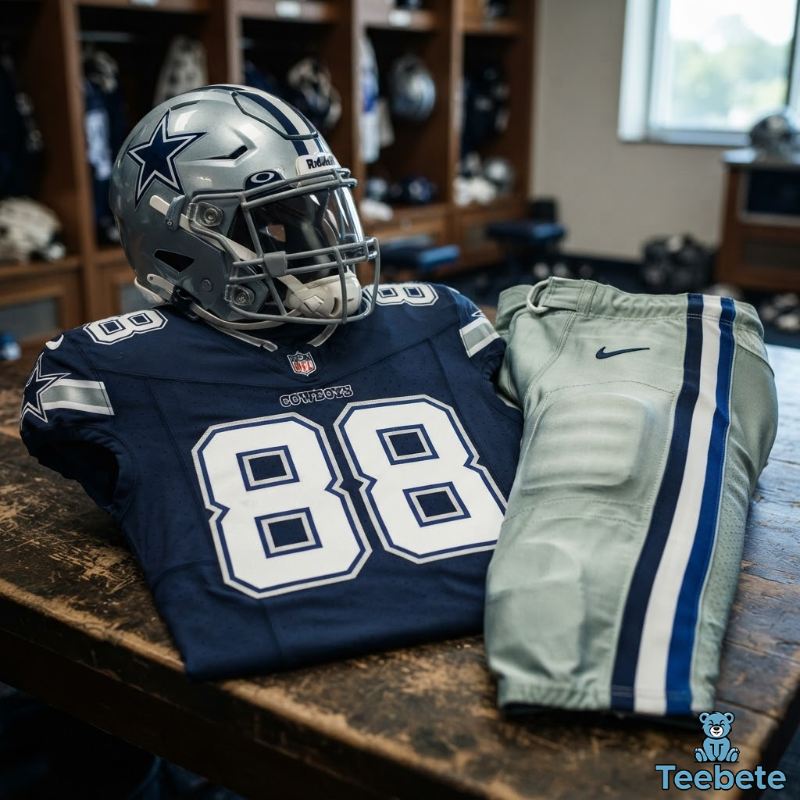
Here’s the part apparel manufacturers rarely explain: none of the three uniform pieces are meant to be color-matched pixel for pixel. The helmet shell uses a hard metallic silver coating that reflects light almost like chrome — closer to automotive paint than fabric dye. The jersey is a woven or knit performance mesh, dyed in bulk, which gives it a flatter, more matte navy or royal blue. The pants go through yet another textile process entirely, with their own dye chemistry and finish. Three materials, three manufacturing pipelines, one shared color story that’s designed to read as cohesive from a distance rather than match exactly up close.
Comparison: Helmet vs. Home Pants
| Feature | Helmet | Home Pants |
|---|---|---|
| Material | Hard metallic shell | Dyed woven fabric |
| Surface | Reflective, glossy | Matte, absorbs light |
| Color name | Metallic Silver | Silver-Green / Cowboys Star Blue |
| Light behavior | Stays fairly consistent | Shifts with lighting and camera |
How Television Changed the Way Fans See Cowboys Colors
Why Older TV Broadcasts Made the Uniform Look Different
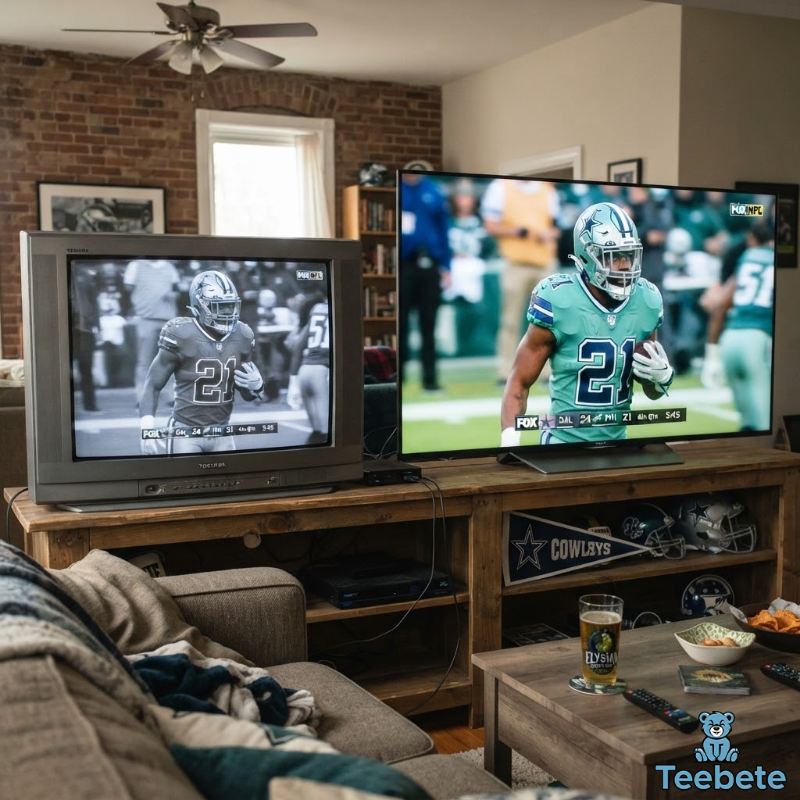
Before high-definition broadcasting, standard-definition cameras and CRT television sets couldn’t reproduce subtle color gradients. That dye-lotted pant color read as a fairly neutral gray on 1980s and 1990s TV sets, which is exactly why generations of fans grew up believing the pants were simply silver. As McCord has described it, the color that showed up on a television screen — or even in a printed photograph shot in the harsh shade-to-sun contrast of the old Texas Stadium — rarely matched what players were actually wearing on the field.
If you’ve watched Cowboys games on both an old tube television and a modern 4K screen, the difference is genuinely striking. On older broadcasts, the pants usually read as plain gray or silver. On today’s sharper displays, that same fabric frequently reveals a noticeable seafoam tint that older technology simply couldn’t resolve — the color was always there, the screens just weren’t good enough to show it.
Why Colors Still Vary Today
Watch a Sunday afternoon game and then compare it with a prime-time matchup. The uniforms can look surprisingly different, even though the players are wearing exactly the same gear. That’s the combined effect of lighting, camera settings, and the screen you’re watching on. Modern camera sensors simply pick up more color nuance than older ones did, which is part of why the greenish tint is so much more obvious now. LED stadium lighting throws a cooler, bluer cast than older sodium or halogen setups. Night games under floodlights look different than day games in natural Texas sun. Camera white balance, individual screen calibration, even weather on an outdoor field — all of it nudges the final color a viewer sees at home, sometimes from one drive to the next in the same broadcast.
The History Behind the Cowboys’ Signature Silver and Blue
How the Original Color Identity Was Created
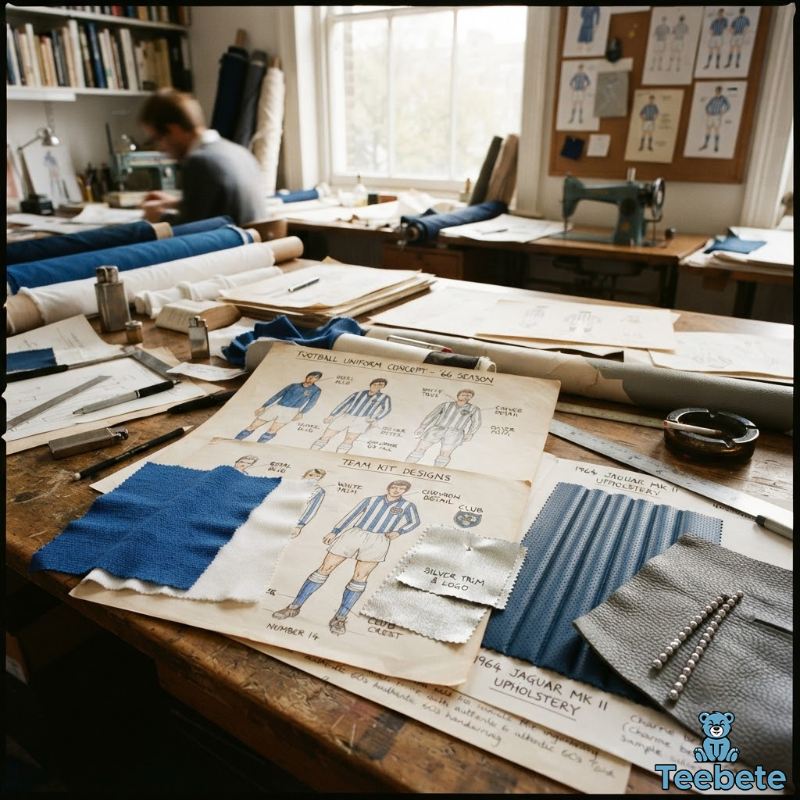
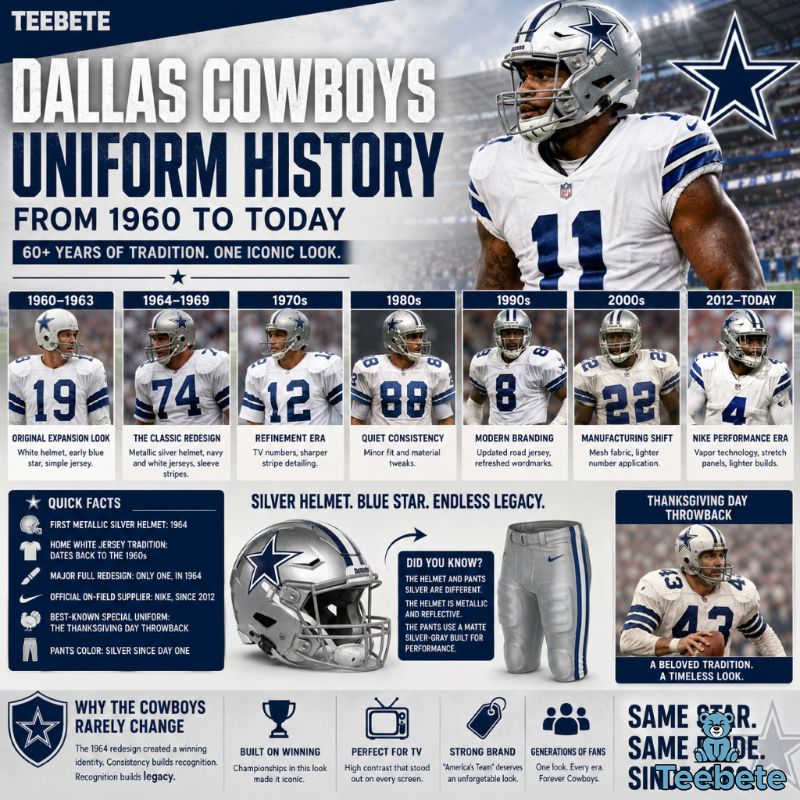
The Dallas Cowboys joined the NFL as an expansion franchise in 1960, built by an ownership group led by Clint Murchison Jr., with Tex Schramm running the front office as general manager and Tom Landry hired as head coach. Schramm is the person most directly responsible for the uniform’s most talked-about detail: the pants color. As the story goes, he once saw a car with an interior upholstery shade he loved and decided the Cowboys’ pants should match it — which is how Cowboys Star Blue entered the team’s visual identity. Strange origin for a color that’s sparked decades of fan debate? Absolutely. But that’s exactly why the story has stuck around as long as the color itself.
Want the fuller picture of how the uniform evolved piece by piece across six decades, from Reebok to Nike and everything in between? Check out the complete Cowboys apparel evolution for a deeper walkthrough of every era.
Why Do the Cowboys Usually Wear White Jerseys at Home?
Most NFL teams wear their colored jerseys at home and save white for the road. The Cowboys do the opposite, and the answer traces back to Texas heat rather than branding preference.
The Texas Climate
Early Cowboys home games were played at the Cotton Bowl and later Texas Stadium, both brutal in the August and September heat. Dark-colored jerseys absorb more heat, so keeping the home team in lighter fabric was as much a comfort decision as a style choice.
The Fan Experience Strategy
There was a competitive angle, too. Wearing white at home forced visiting teams into their darker road jerseys, meaning opponents dealt with more heat retention on the field and sideline during those scorching early-season games — a small but real edge, baked in quite literally.
The Tradition That Became Part of the Brand
What started as a heat-management decision outlived its original purpose once climate-controlled stadiums like AT&T Stadium arrived. Some longtime fans still point to the team’s early-1970s losses in blue jerseys, including the Super Bowl V defeat to the Baltimore Colts, as the moment white became the “lucky” home look in fan psychology. Superstition or not, white-at-home is now inseparable from how people picture the Cowboys, right alongside the star and the silver helmet.
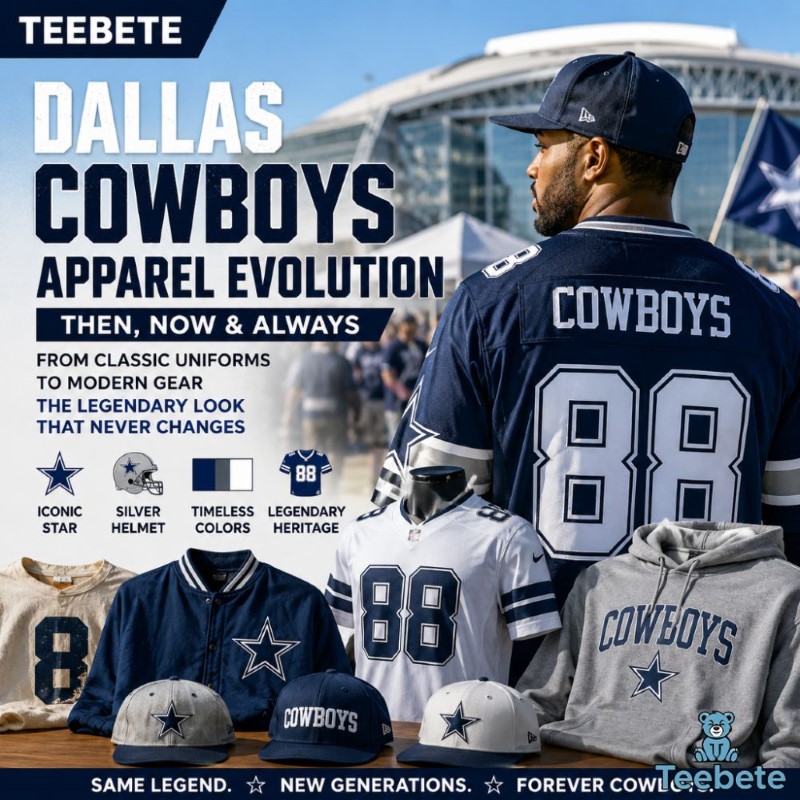
Silver and Blue Across Different Cowboys Apparel
Game-day uniforms aren’t the only place these colors show up, and retail apparel doesn’t always match them exactly.
Why Retail Merchandise Uses Different Blues
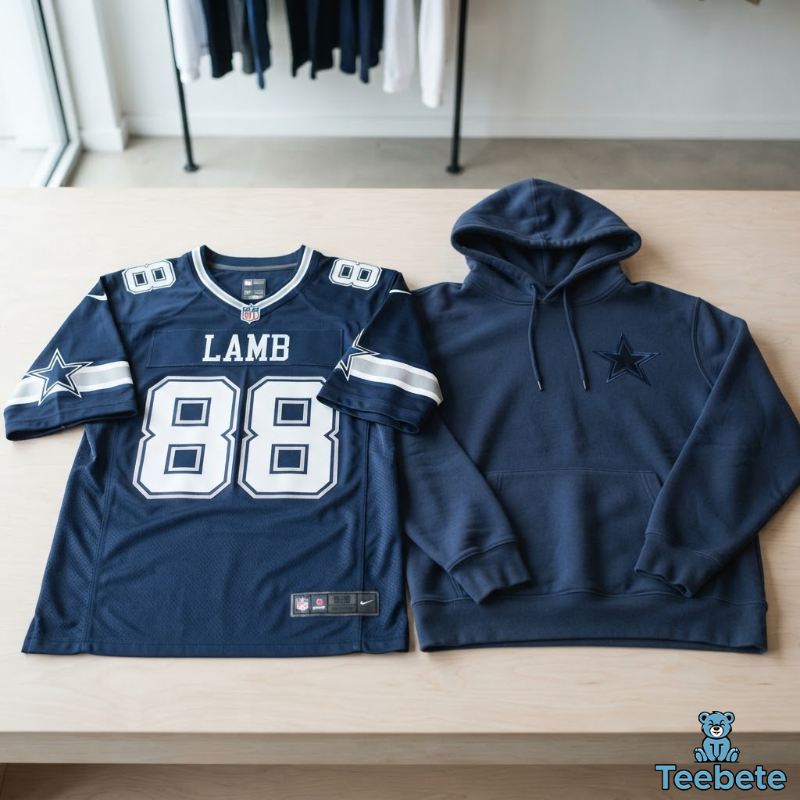
Place an authentic on-field jersey next to a licensed cotton hoodie in daylight and you’ll notice they’re not identical. The jersey usually carries a cooler, more athletic blue tuned for performance fabric, while everyday apparel — hoodies, tees, caps — often leans toward a richer, slightly warmer navy that wears better casually and holds up through repeated washing. Different manufacturers use different fabric bases, and cotton, polyester blends, and printed graphics all take dye differently than the technical mesh used on game-day gear. Add in manufacturing consistency requirements across huge production runs and consumer preference for a bolder look on casual wear, and you get a Cowboys “blue” that’s really a small family of related shades rather than one fixed hex code.
If you’re trying to build a wardrobe that actually looks cohesive across pieces, our guide to choosing fan apparel breaks down what to look for by fabric and cut.
Why Replicas Never Look Exactly Like Game-Worn Uniforms
One detail that often gets overlooked is the difference between authentic game uniforms and retail replicas. NFL game uniforms are engineered for performance first, not retail color-matching. Compression panels, ventilation mesh, moisture-wicking treatments, and supplier-specific dye formulas mean a $300 authentic jersey and a $40 replica can both be “correct” while still looking noticeably different in hand. Replica and fan-shop products intentionally prioritize durability, washability, and price point over exact visual duplication of what’s actually on the field Sunday. That’s not a manufacturing flaw — it’s a deliberate tradeoff, and it’s part of what separates official on-field apparel from the wider licensed merchandising world built around it.
How the Star Logo Works With the Team Colors
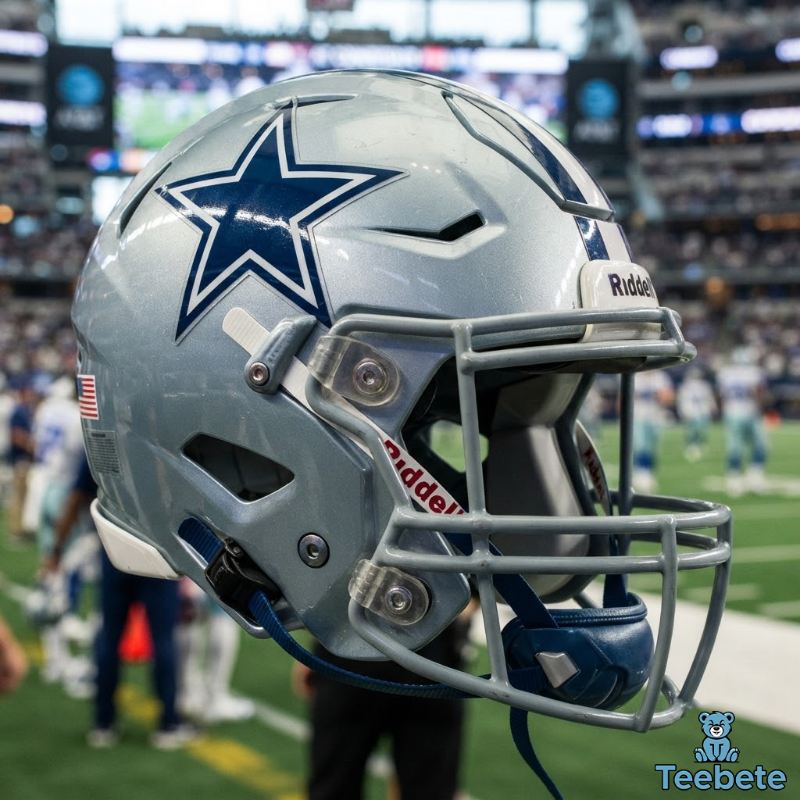
The five-pointed star is doing more visual work than most fans realize. When the Cowboys debuted in 1960, equipment manager Jack Eskridge designed a solid navy blue star on a white helmet, a direct nod to Texas as the Lone Star State. In 1964, when the team switched to silver helmets, Eskridge added a white and navy outline around the star so it wouldn’t visually disappear into the new metallic background. That single tweak is the reason the modern star reads clearly against silver, white, or navy alike — it was engineered for contrast, not just decoration, and it’s held up as one of the most efficient pieces of sports branding in the league.
For the full story of how one simple shape became one of the most recognized emblems in American sports, see our breakdown of the meaning behind the famous star.
Why Silver and Blue Became One of the NFL’s Most Recognizable Color Combinations
Color psychology plays a real role here. Blue broadly reads as trustworthy, stable, and authoritative, while silver comes across as modern, premium, and disciplined — a pairing that fits the “America’s Team” positioning the Cowboys have leaned on for decades. There’s another reason these colors became unforgettable: they’re unusually TV-friendly. High contrast between navy, white, and metallic silver made the Cowboys easy to pick out on broadcasts even during the grainy, low-resolution TV era of the 1970s and 1980s, well before every game aired in HD. That visibility fed directly into merchandising, merchandising fed fan identity, and fan identity looped back into brand recognition — a self-reinforcing cycle most expansion franchises never quite pull off.
Common Myths About Dallas Cowboys Colors
Are the Pants Actually Green?
No. The official fabric is a dye-lotted silver-blue-gray known internally as Cowboys Star Blue. It only reads as green under certain lighting and camera conditions, particularly HD broadcasts and night games.
Is Cowboys Blue the Same as Navy Blue?
Not exactly. The Cowboys use two distinct blues — a deeper navy for the star logo and trim, and a lighter royal blue for the away jerseys and lettering. Related, but not identical.
Have the Official Colors Ever Changed?
The core identity of navy, royal blue, silver, and white has stayed consistent since 1960. What has shifted subtly is the pants’ exact shade, which has moved from a flatter true gray in the 1960s and 70s to the more saturated turquoise-gray fans see today, largely due to changes in uniform suppliers.
Why Do Jerseys Look Different Every Season?
Uniform suppliers have changed over the decades — most notably the 2012 switch from Reebok to Nike as the league’s official provider — and each supplier’s dye process, fabric blend, and printing method introduces small variations. A jersey from one production run can also simply fade or wear differently than one from a newer batch.
Choosing Cowboys Apparel That Matches the Team Look
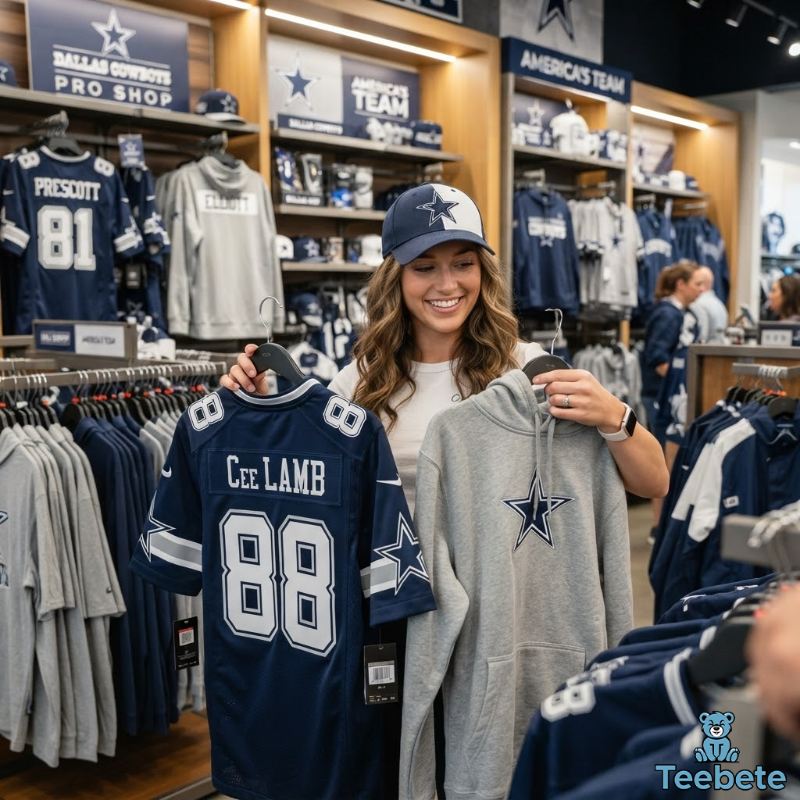
If you’re shopping for gear and want it to actually look right next to your other Cowboys pieces, start by separating “authentic on-field replica” from “everyday fan apparel.” Authentic jerseys are cut and dyed to match game-day specs as closely as NFL licensing allows, while casual apparel prioritizes comfort and durability over exact Pantone matching. Knowing that difference up front saves you from the common letdown of ordering two “blue” items online and having them arrive looking noticeably different in person.
At Teebete, we believe understanding the history and design behind the Cowboys’ signature colors helps fans choose apparel that reflects both the team’s tradition and their own style.
Key Takeaways About Dallas Cowboys Colors
- The official colors are navy blue, royal blue, silver, and white, with a distinct silver-green shade reserved for the home pants.
- The home pants’ greenish appearance comes from a dye-lotted fabric called Cowboys Star Blue, not a uniform redesign.
- HD and 4K broadcasting made the pants’ true color far more visible than older CRT television ever could.
- Stadium lighting, camera sensors, and white balance settings still cause real color variation game to game.
- The white-at-home tradition began as a practical response to Texas heat, not a branding gimmick.
- Retail apparel and replica jerseys use different fabrics and dye processes than game-day uniforms, which is why shades can vary between products.
- The star logo’s white-and-navy outline, added in 1964, was specifically engineered to stand out against the silver helmet.
- Nike has manufactured the Cowboys’ official on-field uniforms since 2012 as the NFL’s exclusive apparel provider.
Questions Fans Often Ask About Dallas Cowboys Colors
What is the official blue used by the Dallas Cowboys?
The Cowboys use two blues: a deep navy tied to the star logo and trim, and a royal blue used on the away jerseys and lettering.
Why do Cowboys pants sometimes appear green?
Their home pants use a dye-lotted silver-blue-gray fabric that reads as green or seafoam under HD cameras, sweat, and certain stadium lighting.
Do Cowboys uniforms use more than two colors?
Yes. Beyond navy and silver, the uniform system includes royal blue, white, and a distinct silver-green shade specific to the pants.
Why do the helmet and pants look different?
They’re made from entirely different materials — a hard metallic helmet shell versus a dyed fabric pant — so they reflect light differently even though they’re meant to complement each other visually.
Why do the Cowboys wear white jerseys at home?
The tradition started to help players stay cooler during hot early-season games in Texas and to push visiting teams into darker, heat-absorbing road jerseys.
Are retail Cowboys shirts the same color as official uniforms?
Not always exactly. Retail fabrics and dye processes differ from on-field gear, which can produce a slightly different shade of blue or navy.
Has the Cowboys color palette changed over time?
The core navy, royal blue, silver, and white identity has held since 1960, though the specific pant shade has shifted subtly across different uniform suppliers, including the move to Nike in 2012.
Why is the silver helmet different from silver clothing?
The helmet uses a hard, reflective metallic coating, while silver-toned clothing relies on dyed fabric, which behaves completely differently under stadium and broadcast lighting.

Hi, I’m Mia Wilson. I’m a journalist and content creator based in New York with over six years of experience covering sports, holidays, fan culture, and community events across the United States. I focus on exploring team histories, traditions, celebrations, and the broader impact of sports and cultural events on local communities. I’m passionate about providing accurate, engaging, and educational content for readers of all ages, helping them understand the stories, experiences, and events that make sports and celebrations so meaningful.